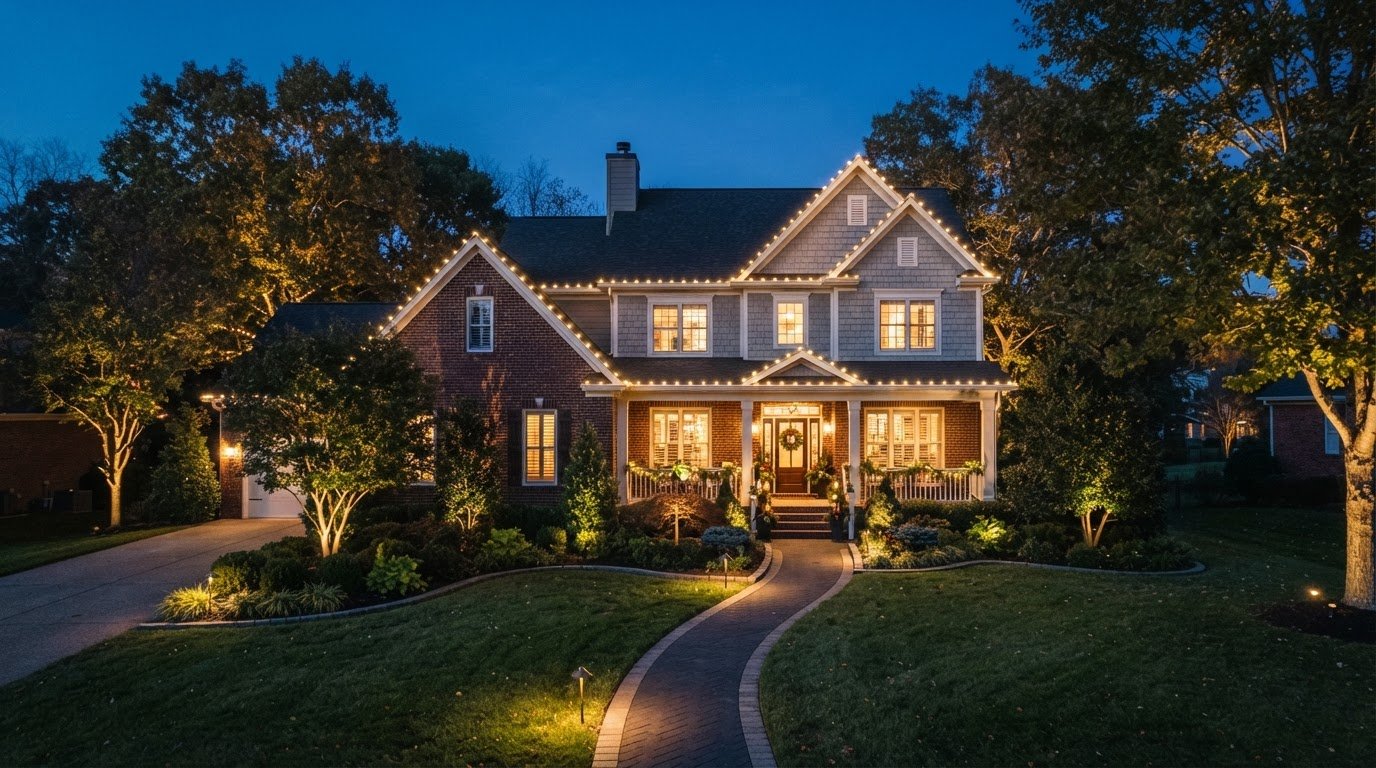
A polished tree-lighting display starts with a plan. If you’re considering tree wrapping for Christmas lights Nicholasville, first decide which parts of the tree to highlight, then choose outdoor-rated lights and map a safe route for the strands and cords. The tree’s shape, size, and visibility will help determine how much coverage makes sense.
This guide explains how to plan a proportional display for your Nicholasville yard, estimate strand length, prepare the work area, and wrap from the trunk outward. It also covers common mistakes and when professional holiday lighting installation can simplify the project. A little preparation helps you work carefully and create a display that suits both the tree and its surroundings.
Tree Wrapping for Christmas Lights in Nicholasville: Start with the Right Tree
Tree wrapping means securing outdoor lights around a tree trunk or selected branches to create a defined seasonal display. Before choosing strands, view the tree from a distance and consider its size, shape, visibility, and surroundings. A healthy-looking tree with a clear working area may be a more practical choice than the largest tree on the property.
When planning tree wrapping for Christmas lights Nicholasville, consider both the view and the installation. A tree near the home may be easier to access, while one by the driveway or front walk may be more visible. Before settling on a location, trace the route from the tree to a suitable outdoor outlet and check that cords won’t cross a walkway or driveway.
Which trees work best for Christmas light wrapping?
A visible trunk with a relatively clear lower canopy is a straightforward choice because it gives you a defined surface for an even spiral. Trees with prominent, sturdy-looking branches can support a broader display. On an evergreen, selectively lighting accessible outer branches can emphasize the tree’s shape without trying to cover every branch.
Consider how you’ll reach the tree. Choose one you can work on from a stable position, and avoid pushing strands into dense growth or pulling branches aside to make a route. Plan the cord path as well, keeping it out of walkways and driveways where someone could trip.
Trunk wrapping highlights the tree’s central column, while branch lighting follows the canopy to show more of its shape. Choose an approach that fits the tree and the access available before counting strands.
Plan a balanced display for a Nicholasville yard
View the tree from the places people will see it: inside the home, from the street, along the driveway, and on the approach to the entrance. A display that looks bright from one window may be partly hidden from the street. Walking around the property helps you identify the most important viewing angle.
Compare the tree’s visual weight with the house and any other seasonal decorations. One well-positioned tree can be enough. Keep the display in scale with the yard, and let a prominent tree serve as a focal point instead of competing with every window, path, and entrance feature.
Palisades Outdoor Solutions provides holiday lighting installation in Nicholasville and nearby communities. A planned layout can help coordinate the tree with the home’s other holiday lighting.
Choose Outdoor Christmas Lights and Prepare Before Wrapping
Once you’ve chosen a tree and decided which parts to highlight, prepare the lights before bringing them to the trunk. Use light strands and extension cords rated for outdoor use, and follow the manufacturer’s instructions for testing, connections, and placement. Plug outdoor connections into a GFCI-protected outlet. Testing the strands and planning the cord route in advance can prevent interruptions once you start wrapping.
Inspect every strand, plug, and section of insulation before placing lights around the tree. Look for cracked or frayed insulation, loose connections, damaged sockets, or other visible wear. Set aside any strand that appears damaged rather than installing it.
Select lights that fit the tree and intended look
Mini lights can follow a trunk’s curves and smaller branches, while purpose-made tree-wrap lights can create a more focused trunk display. Compare the spacing and wire visibility with the tree, and make sure the strand can follow the planned route without being pulled tight.
Choose a consistent bulb color and appearance so the finished wrap reads as one display. If you’re combining strands, compare them before installation. Differences in color, spacing, or wire appearance can be noticeable where one strand ends and another begins.
Estimate strands and check the work area
Measure the trunk circumference where the wrap will begin, then choose the spacing between spiral passes. Multiply the circumference by the number of planned turns to estimate the length needed for that section. If the trunk narrows as it rises, measure at more than one height or account for the changing circumference. Include the cord route to the outlet and any branches in your estimate.
Use the estimate as a planning guide, not a reason to stretch a strand to its limit. Check the strand length and the manufacturer’s connection guidance before deciding how many you need. Leave enough slack to position the lights neatly without putting tension on wires or plugs.
- Test each strand as directed by its manufacturer before arranging it around the tree.
- Map the cord route to the outdoor outlet, keeping cords out of walkways and driveways.
- Position connections so they don’t hang under tension or rest where people are likely to step.
- Arrange plugs and connections according to the product instructions, and protect them from exposure as directed.
Palisades Outdoor Solutions provides holiday lighting installation in Nicholasville and nearby communities. To discuss a seasonal lighting plan for your property, contact the team.
Trunk Wrap or Branch Wrap? Choose the Right Christmas Light Coverage
The amount of a tree you illuminate shapes the finished display. A visible trunk may look complete with a neat spiral, while a tree with open, defined limbs may benefit from lights on a few selected branches. For tree wrapping for Christmas lights Nicholasville homeowners can base coverage on the tree’s shape, visibility from the house or street, and the look they want. More lights don’t automatically make a better display.
| Coverage | Finished look | Planning and strands |
|---|---|---|
| Trunk only | A clean outline that emphasizes the trunk and the tree’s main structure. | Focus on an even spiral, consistent spacing, and a clear stopping point. Strand needs depend on trunk size and the spacing you choose. |
| Trunk and selected branches | A broader look that can add depth and trace parts of the canopy. | Requires a planned route across the trunk and chosen limbs. Strand needs vary with the branches included and the path between them. |
Neither approach is automatically more polished. Too many lights can obscure the tree’s shape or compete with the home’s other decorations. A considered layout gives the display a focal point and keeps it in scale with the tree and yard.
When trunk-only wrapping creates a cleaner look
A trunk-only wrap works well when the trunk is a strong feature from the main viewing angle. Follow an orderly spiral and keep the distance between passes as consistent as practical. Decide where the wrap will begin and end, such as at the base and below the first major branch. A clear boundary helps the result look intentional.
This approach can also suit a tree with dense upper growth or difficult-to-reach branches. Let the trunk and primary branching structure provide the visual interest. There’s no need to light every limb.
When to extend lights onto selected branches
Lighting selected branches can add dimension, especially when a few prominent limbs are easy to distinguish. Sketch a simple route first: mark the trunk section, the branches to follow, and where each path should stop. Planning helps avoid crossed strands, crowded junctions, and abrupt changes in direction.
Keep the selection restrained. Choose branches that are accessible and appear stable, and don’t pull them aside or force lights into tight growth. If a route is awkward to reach or would stretch the strand, revise the plan instead of adding tension. The goal is to show the tree’s form, not cover every available surface.
Step back periodically and view the display from the angle people will see it. If the lights already define the tree clearly, stop there. Extend the wrap only when it serves a specific purpose, such as drawing attention to an open branch pattern.
How to Wrap a Tree with Christmas Lights: A Careful Step-by-Step Method
A steady pace makes it easier to keep the spiral even and catch problems before they’re hidden by more lights. For tree wrapping for Christmas lights Nicholasville homeowners can use this sequence as a guide, while following the instructions supplied with each strand for connections, placement, and use. Stop if the tree or work area is difficult to reach safely.
- Prepare the work area. Clear tools, cords, and other obstacles from around the tree. Set out the lights where you can reach them without pulling on the wires. Confirm the route to the outdoor power source won’t cross a walkway or driveway. Use a stable ladder only when appropriate, don’t overreach, and don’t climb higher than you can safely manage.
- Test the strands. Follow the manufacturer’s testing instructions before installation. Check plugs and insulation for visible damage, and set aside any strand that appears worn or damaged. Keep the lights unplugged while positioning them unless the product instructions specify otherwise.
- Begin near the base. Choose a starting point that lets the cord follow the planned route toward the power source without creating a trip hazard. Hold the first loop in place without puncturing the tree or pinching the wire. Don’t use nails or staples to secure lights because they can damage wire insulation.
- Wrap upward with even spacing. Move in a steady spiral, keeping the distance between passes consistent with your plan. Let the strand rest against the trunk instead of pulling it tight. After a few turns, pause and check the spacing from the main viewing angle. Correct uneven sections before continuing upward.
- Finish the planned coverage. Stop at the boundary you chose for the trunk, or continue onto selected branches if they’re part of the design. Keep the strand loose enough to avoid tension on the wire or tree. Position plugs and connections as directed by the manufacturer, and don’t exceed the product’s instructions for connecting strands.
Wrap the trunk from the base upward
As the trunk changes shape, make small adjustments to keep the spiral visually steady. Pause at a natural stopping point and look from a few steps back. If a section bunches or drifts, reposition it gently before continuing. For a trunk-only wrap, stopping below a major branch often looks more finished than ending abruptly.
Finish branches, connections, and the display
If your layout includes branches, follow the selected paths without pulling limbs or forcing lights into tight growth. Arrange cords and connections according to product instructions, keeping wires clear of foot traffic and free from tension. Before switching on the display, look for crossed strands, crowded areas, or loose loops. Make adjustments with the lights unplugged when the instructions call for it.
If the tree is too tall or difficult to reach safely, leave the elevated work to a professional. Palisades Outdoor Solutions provides holiday lighting installation in Nicholasville and nearby communities. Contact the team about holiday lighting installation for help planning or completing your display.
When to Choose Professional Tree Wrapping in Nicholasville
DIY wrapping can suit a modest tree with easy access and a simple layout. A taller tree, hard-to-reach branches, or several trees with different shapes make planning and installation more demanding. Consider whether you can work safely and take the time needed to keep the coverage consistent.
For tree wrapping for Christmas lights Nicholasville homeowners can weigh a few practical questions:
- Can you reach every part of the planned wrap from stable ground or another safe working position?
- Does the design involve elevated branches, a broad canopy, or more than one tree?
- Do you have enough time to plan the layout, place the lights carefully, and review the finished pattern?
- Are you comfortable following the light manufacturer’s directions for setup and connections?
Signs a DIY tree wrap may not suit the project
If completing the design means leaning far from a ladder, stretching to reach a branch, or climbing higher than you can safely manage, stop and reconsider. The same applies if the tree is too large to inspect from a secure position. Avoid electrical work you’re unfamiliar with. Follow the product instructions and seek appropriate professional help rather than improvising.
Time matters, too. A display combining several trees, trunks, selected limbs, and other seasonal lighting takes more coordination than a simple wrap. If you’re likely to rush, leave uneven sections, or struggle to keep cords organized, professional installation may be a more practical option.
Plan a professionally installed holiday display
Palisades Outdoor Solutions provides holiday lighting installation in Nicholasville and nearby communities. A planned seasonal display can coordinate the tree with the rest of the property’s holiday lighting. The layout can take the home, the tree’s visible features, and your preferred look into account, without requiring you to manage each installation detail yourself.
Choose the approach that fits your access, schedule, and confidence. If you’d like help planning your seasonal display, explore holiday lighting installation or contact Palisades Outdoor Solutions.
Make Your Nicholasville Tree Display Your Own
Let the tree guide your choices. A wrap can be understated or more detailed, but it should look considered from the first loop to the last. Decide what you want to highlight: the trunk’s shape, a few distinctive branches, or a focal point along the approach to your home. A clear goal helps keep the project manageable and the finished display in harmony with the yard.
If tree wrapping for Christmas lights Nicholasville feels like more work than you want to take on, professional help is another option. Palisades Outdoor Solutions provides holiday lighting installation in Nicholasville and nearby communities, along with outdoor lighting solutions for properties. A seasonal display can be planned as part of the way you light and enjoy your outdoor spaces.
To discuss a seasonal display for your property, contact Palisades Outdoor Solutions about holiday lighting.
Frequently Asked Questions
How many Christmas lights do I need to wrap a tree?
Measure the trunk and decide how much space you want between each spiral. A wider trunk or closer spacing means more wire for each upward turn. Add length for branches only if they’re part of your design, and include the route from the tree to the power source. Check each set’s length and connection instructions. There’s no universal strand count for every tree.
Can I wrap Christmas lights around a wet tree?
Wait until the tree and work area are dry before handling lights or electrical connections. Don’t install in rain or when the ground, ladder, or other surfaces are slippery. Use outdoor-rated lights as their manufacturer directs, and position plugs and connections according to the product instructions. If conditions turn wet while you’re working, pause until it’s safe to continue.
How do I secure Christmas lights without damaging a tree?
Secure lights gently, without nails, staples, tight ties, or other methods that cut into bark or pinch the wire. Follow the light set’s instructions for spacing and attachment, and don’t pull branches into position to make a strand fit. Leave the tree room to move naturally. If the lights won’t stay in place without force, choose a different route or simplify the display.
When should I put Christmas lights on outdoor trees?
Install them when you have enough time to work carefully and the tree and work area are dry and safe to access. Nicholasville conditions vary, so one calendar date won’t suit every property or tree. Plan and test the lights ahead of installation, leaving time to adjust the layout. Avoid rushing to finish just before you want to switch on the display.
Are LED lights better for wrapping trees than other Christmas lights?
LED lights can be a good option, but the right choice depends on the look you want and whether the set is rated for outdoor use. Compare bulb color, spacing, and wire visibility with the tree and the rest of your display. If you plan to connect multiple strands, check their instructions for compatibility and connection limits. A consistent appearance can matter as much as bulb type.
Can I wrap Christmas lights around an evergreen tree?
Yes, an evergreen can work if its shape and accessibility suit your plan. Decide whether you want to emphasize the trunk, trace a few visible branches, or highlight part of the tree’s outline. Avoid forcing strands through dense growth, which can make placement awkward and the pattern hard to follow. Use outdoor-rated lights as directed, and keep the layout simple enough to install without pulling or bending branches.
Should I remove Christmas lights from a tree after the holidays?
Follow the manufacturer’s guidance and remove the lights carefully rather than pulling strands through branches. Unplug them before handling, then loosen each section without yanking or tightening the wire around the trunk. Check for visible wear as you take the display down so damaged strands aren’t put away for next season. Store the lights as directed, and don’t attempt removal that requires unsafe reaching or climbing.